It's not that significant, but it is typical.
British politics and the media that comment on it are trapped in a permanent spiral of putrefying idiocy. Politicians are - with rare exceptions - liars. We all know about Bliar and Iraq, of course. And it's hard not to suppress a snigger - or a groan, depending on your mood - when Cameron starts referring to Gandhi (and don't get me started on that single braincelled creature `Lord' Geldof). But is it too much to expect that those newspaper columnists who are extremely well-paid to pore over their pronouncements and interpret them for us should filter them for some kind of truth?
Don't be stupid, of course it is! Here's a supreme idiot for you - Andrew Rawnsley in today's Observer, on Blair's exit strategy - "But he is bound to be tempted to look for 'tops', which could include the withdrawal of British troops from an Iraq which is clearly on the path to improvement". Clearly on the path to improvement. Yes, the idiot really did say that. When did he last go to Iraq? Here's a letter from a Baghdad resident to George W.Bush (the Butcher of Fallujah). Who knows more about the situation in Iraq - someone who lives there or a `journalist' (i.e. paid propagandist) who sits on his fat overpaid arse in London and repeats whatever some Blairite lackey feeds him?
Is there a single newspaper commentator who isn't simply an echo of the liars of the British political class? Rags like the Observer - and their braindead propagandists - are simply a complete waste of time. You'd get more truth from the Beano.
Sunday, January 01, 2006


Monday, December 26, 2005
Blair's evil twin `worried about gun crime'
Apparently, Sir Ian Blair, the well-known liar about the police murder of Jean Charles de Menezes at Stockwell tube station on 22 July 2005, is worried about rising gun crime - not including, of course, the murder of de Menezes which is currently undergoing multiple coats of whitewash on Blair's behalf. So we Londoners are to be treated to an increase in the numbers of de Menezes' murderers - up to 200 extra armed police apparently, even before the official whitewash is out.
So who gets it next - me, you, a friend or relative of mine or yours, or most likely a total stranger (so that's alright then). Of course Blair, and his evil twin our war criminal prime minister couldn't care less how many innocents the police shoot (how many have died in Iraq now?) as long as there's no publicity. (By the way, you'd better carry some ID if you want to be identified). Or as long as they can claim that he or she `vaulted the barrier' or `was wearing unseasonal clothing', and not get found out about it.
Even if there is publicity they can always rely on official cover-ups, and our complacent `free press'. How long have the investigators into de Menezes' murder been sitting on their spotty arses now waiting for the heat to die down so they can issue their official cover-up and Cur Ian Blair can claim vindication for the casual murder of an innocent on behalf of Tony Blair's policy of licking the arse of the Butcher of Fallujah (George W.Bush if you have to ask, but I'm sure you don't)? How long does it take to establish the truth about state-sanctioned murder (the answer - forever, if necessary).
Then again, they can always rely on the good-old BBC, sustained by our licence-fees to feed us lies on the evil twins behalf. Jean Charles de Menezes was `mistakenly killed' if you believe BBC Newsroom South-East, or whatever their Blairite propaganda broadcasts are called these days. If Emily Maitliss is going to read such barefaced lies straightfaced to camera surely she should be smeared in the blood of the kill, how else are the boys in blue really going to enjoy their work. Let's not be shamefaced about it. After all, he's just the first of many, we have to get used to these things. Who knows, you may be next. And if you won't get off your fat arse to complain aboout the murder of the innocent Mr de Menezes, who's going to complain about yours? Not the BBC, that's for sure (or the `Independent' Police Complaints Commission).
We are ruled by scum, and nobody gives a toss.
So who gets it next - me, you, a friend or relative of mine or yours, or most likely a total stranger (so that's alright then). Of course Blair, and his evil twin our war criminal prime minister couldn't care less how many innocents the police shoot (how many have died in Iraq now?) as long as there's no publicity. (By the way, you'd better carry some ID if you want to be identified). Or as long as they can claim that he or she `vaulted the barrier' or `was wearing unseasonal clothing', and not get found out about it.
Even if there is publicity they can always rely on official cover-ups, and our complacent `free press'. How long have the investigators into de Menezes' murder been sitting on their spotty arses now waiting for the heat to die down so they can issue their official cover-up and Cur Ian Blair can claim vindication for the casual murder of an innocent on behalf of Tony Blair's policy of licking the arse of the Butcher of Fallujah (George W.Bush if you have to ask, but I'm sure you don't)? How long does it take to establish the truth about state-sanctioned murder (the answer - forever, if necessary).
Then again, they can always rely on the good-old BBC, sustained by our licence-fees to feed us lies on the evil twins behalf. Jean Charles de Menezes was `mistakenly killed' if you believe BBC Newsroom South-East, or whatever their Blairite propaganda broadcasts are called these days. If Emily Maitliss is going to read such barefaced lies straightfaced to camera surely she should be smeared in the blood of the kill, how else are the boys in blue really going to enjoy their work. Let's not be shamefaced about it. After all, he's just the first of many, we have to get used to these things. Who knows, you may be next. And if you won't get off your fat arse to complain aboout the murder of the innocent Mr de Menezes, who's going to complain about yours? Not the BBC, that's for sure (or the `Independent' Police Complaints Commission).
We are ruled by scum, and nobody gives a toss.
Thursday, September 29, 2005
Zarqawi Number 2 Ejected from Labour Conference

In breaking news, the victorious Coalition has dealt a massive blow to the Iraqi insurgency by locating, ejecting and subsequently detaining Zarqawi's number 2 under the Terrorism Act.
This evil man had the nerve to attend the New Labour rally at a secret location (Nuremberg) and heckle the great Foreign Secretary Heinrich Straw. Fortunately our great leader had the presence of mind to set a number of fat thugs on the vicious 82 year old and bodily throw him out, where our wonderful policemen immediately detained him as a suspected terrorist.
SO PERISH ALL ENEMIES OF THE THOUSAND YEAR NEW LABOUR REICH!
Wednesday, September 28, 2005
New Labour Assault 82 Year Old Man
So much for Tony Blair's `respect agenda'! It seems `respect' doesn't have to be extended to anyone who disagrees with New Labour. An 82 year old man - apparently a veteran Labour Party member of over 50 years - who heckled the odious Jack Straw about Iraq at the Party Conference, was manhandled out by a fat New Labour thug (a David Aaronovich lookalike).
AND THE POLICE HELD HIM UNDER THE PREVENTION OF TERRORISM ACT (according to BBC-TV News)!!!!!!!! No doubt that ignoramus Charles Clarke is even now signing the order for his house arrest. And as he apparently came to this country as a fugitive from the Nazis, he can expect to be deported to Germany in due course.
So perish all who glorify terrorism by maligning honest New Labour ministers.
You really couldn't make it up. What did we ever do to deserve this government of war criminal scum.
AND THE POLICE HELD HIM UNDER THE PREVENTION OF TERRORISM ACT (according to BBC-TV News)!!!!!!!! No doubt that ignoramus Charles Clarke is even now signing the order for his house arrest. And as he apparently came to this country as a fugitive from the Nazis, he can expect to be deported to Germany in due course.
So perish all who glorify terrorism by maligning honest New Labour ministers.
You really couldn't make it up. What did we ever do to deserve this government of war criminal scum.
Sunday, September 25, 2005
Stop The War March London 24/9/05 post 2


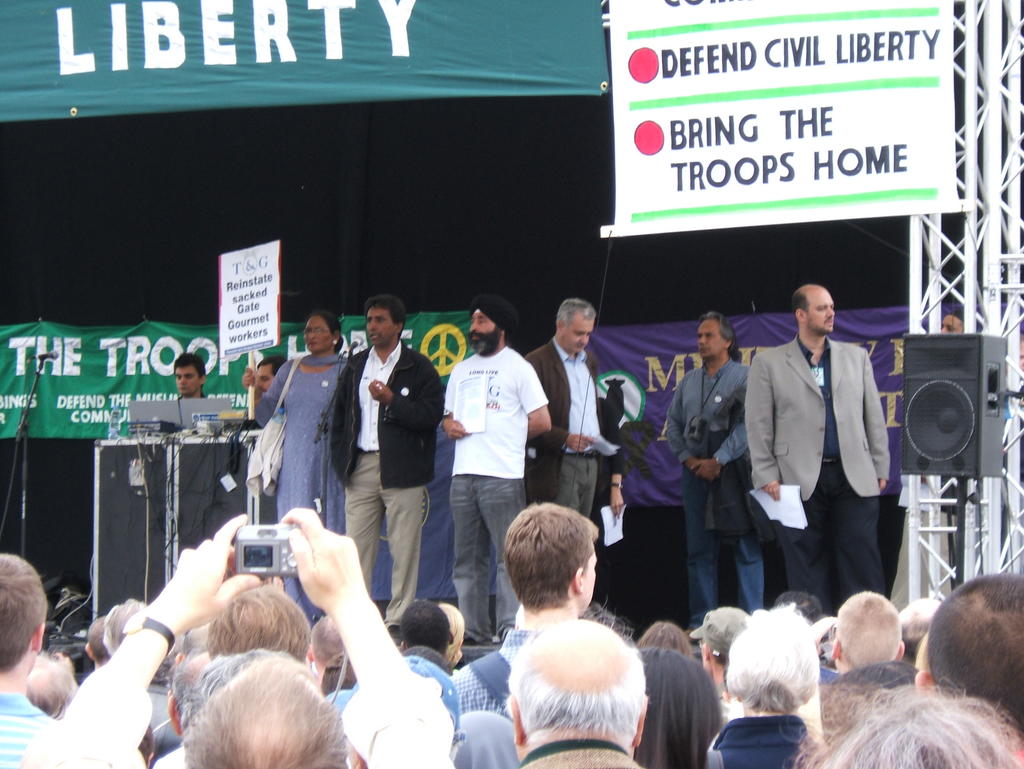

There were some very good speakers in Hyde Park. Several people spoke for Military Families Against the War; and there was Tony Benn, Jeremy Corbyn, Scottish MSP Colin Fox, and two brave young women from the Jean Charles de Menezes campaign - justice4jean.com. There was Bianca Jagger, Brian Eno, Tariq Ali, John Rees, Lindsey German, an Iraqi doctor, an Iraqi author, Tom Hayden, Gate Gourmet workers, and an excellent speech from John Pilger. My apologies to those speakers I missed for not listing them here.
Stop The War March London 24/9/05


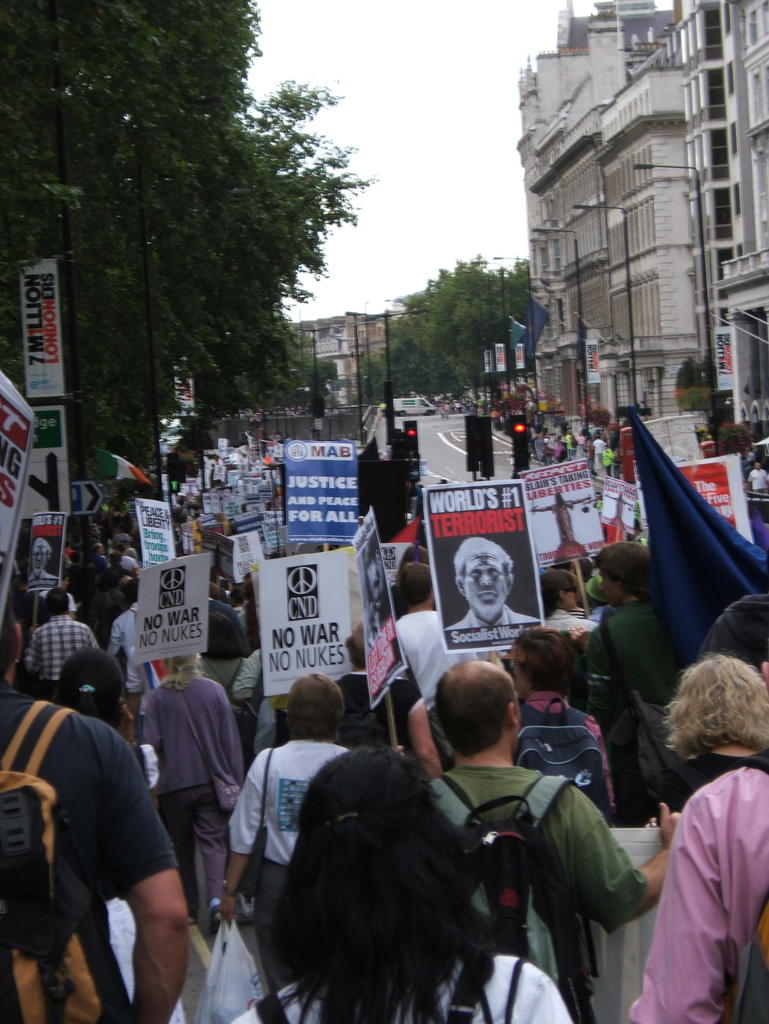
I went on the march and took some photos, examples above. At a guess there were more than 10,000 on the march (as we know the police estimates are always ridiculously low for political reasons), but less than 100,000. Okay, that leaves a lot of room for guesswork but I only just scraped Maths O-Level, don't ask me to count to 100,000!
Sunday, August 28, 2005
Abbey Gardens, Bury St Edmunds

I now have a Flickr photostream. I'm not promising anything particularly interesting, but if you want to, take a look.
Thursday, August 18, 2005
The Blairs Have No Integrity
Another unpublished letter to the shitty Guardian, sent 17/8/05.
Dear Editor,
Thanks to a fine piece of reporting by ITV News (putting BBC News to shame) we now know there was as much truth to Ian Blair's account of how the police came to shoot Mr de Menezes at Stockwell tube station, as there was to Tony Blair's account as to why British troops invaded Iraq.
If either Blair had an ounce of integrity their resignations would already have been announced. As neither does, we can look forward to continuing British government support for war crimes in Iraq, together with further innocents shot by the Metropolitan Police.
How wonderful it is to live in a `modern democracy' (where the will of the people can be safely ignored).
Yours faithfully,
Grouchy.
Dear Editor,
Thanks to a fine piece of reporting by ITV News (putting BBC News to shame) we now know there was as much truth to Ian Blair's account of how the police came to shoot Mr de Menezes at Stockwell tube station, as there was to Tony Blair's account as to why British troops invaded Iraq.
If either Blair had an ounce of integrity their resignations would already have been announced. As neither does, we can look forward to continuing British government support for war crimes in Iraq, together with further innocents shot by the Metropolitan Police.
How wonderful it is to live in a `modern democracy' (where the will of the people can be safely ignored).
Yours faithfully,
Grouchy.
Thursday, August 11, 2005
Guardian Blairite Garbage
Text of an unpublished (of course) letter to the Blairite Guardian on 10th August 2005:
Dear Editor,
John Lloyd's opinion piece in today's Guardian employed what has come to be standard Blairite dishonesty, saying that in The Guardian `These pages have been host to several pieces arguing, in essence, that we British had it coming (it being terrorist attacks by those acting in the name of extreme Islamism').
What a load of rubbish. What articles is Lloyd referring to? There has not been a single one. What Lloyd is doing is following The Great Leader's dishonesty in claiming that explanation = justification. And we all know why Blair did that. Because British foreign policy has landed us in this current mess. Naturally, Lloyd attempts to cover this up.
Feeble effort, 0 out of 10, must try harder. What about telling the truth for a change?
Yours faithfully,
Grouchy.
Dear Editor,
John Lloyd's opinion piece in today's Guardian employed what has come to be standard Blairite dishonesty, saying that in The Guardian `These pages have been host to several pieces arguing, in essence, that we British had it coming (it being terrorist attacks by those acting in the name of extreme Islamism').
What a load of rubbish. What articles is Lloyd referring to? There has not been a single one. What Lloyd is doing is following The Great Leader's dishonesty in claiming that explanation = justification. And we all know why Blair did that. Because British foreign policy has landed us in this current mess. Naturally, Lloyd attempts to cover this up.
Feeble effort, 0 out of 10, must try harder. What about telling the truth for a change?
Yours faithfully,
Grouchy.
Tuesday, August 09, 2005
TV Review - Hollywood UK:British cinema in the sixties****
Hollywood UK Episode Two: Making It In London BBC4 8th August 2005
This is the 2nd of 5 episodes from the series originally broadcast on BBC2 in 1993.
And so we come to `Swinging London'. Did it really exist - as famously declared by Time magazine in April 1966 - or was it just a media construct? A clip of an interview with Julie Christie (from Peter Whitehead's important Tonite Let's All Make Love in London - uncredited by the BBC) from 1966 or 67 shows her saying about the 60s, `A good time is much easier had by all than ever before'. Certainly true by comparison with the 1950s, but it was much truer for `the beautiful people' that Terence Stamp discusses moving amongst here, than for the general population. All the same, something was happening, as evidenced by the films discussed.
Presenter Richard Lester looks at these films - Darling (1965), A Hard Day's Night (1964), The Pleasure Girls (1965), The Knack (1965), Georgy Girl (1966), Morgan: A Suitable Case for Treatment (1966), Alfie (1966), Far From the Madding Crowd (1967), and Poor Cow (1967).
Darling is used to set the scene. In contrast to the gritty northern materialism of the `kitchen-sink' films of the first programme in the series (see previous review), we now have glamour with a capital G, as personified by Julie Christie. Her character, Diana Scott, is an ambitious attractive young woman who is determined to lead her own life. She wants to be economically and sexually independent. Her fascination with powerful men leads her to move up the social ladder from man to man until she finally marries an Italian prince. But it ends in tears with the character isolated and alone in an Italian castle. According to writer Frederic Raphael, the 60s saw a presumption that what was previously considered as `bad behaviour' should be accepted as the norm. So the script for Darling, in displaying Diana Scott's bad behaviour, was a social comment intended to suggest that a better society was needed - in Raphael's words, `i.e. God help us, a socialist one' (this comment says a lot more about Raphael than socialism).
A Hard Day's Night, a `documentary-style' film about a day in the life of The Beatles has been famously described by film critic Andrew Sarris as `the Citizen Kane of jukebox movies'. Yet, as revealed here by United Artists executive David Picker, the film was only made because UA would get a soundtrack album out of it. In fact the film cost only £190,000 to produce (presumably making it one of the most profitable films of all time). Writer Alun Owen tailored the on-screen characters to the Beatles own personalities, enabling fresh lively performances which captivated audiences across the world. The programme takes in the difference between the `realism' of this film and the `let's do the show right here' showbizzy nature of the Cliff Richard precedents, The Young Ones (1961) and Summer Holiday (1962), which director Richard Lester was able to react against.
The Pleasure Girls' fairly realistic depiction of life in London for girls who had just moved there - involving flatmates, independence and boyfriends - is contrasted with Lester's ownThe Knack, a more stylised film about young people in the capital. The latter utilised a high-key photographic style - thus rendering more of an advertising-shoot look - and a kind of Greek Chorus of elderly people commenting on the antics of the younger generation. Lester admits to have used every trick he could think of in the film. All this makes it something of a microcosm of early swinging London. `The knack', by the way, is the ability to pull women. The full title of the film is The Knack...and how to get it.
Georgy Girl explored the other side of this question as Georgy, played by Lynn Redgrave, was frustrated and unable to get what she wanted sexually. Georgy, homely and warm-hearted, shares a flat with her polar opposite, sexy but cold-hearted Meredith, played by Charlotte Rampling. Meredith's boyfriend is Jos, played by Alan Bates. Meredith gets pregnant, has the baby, but doesn't want it. Georgy solves her problem by marrying her old guardian - James Mason - so that she can adopt her friend's baby. How very different from the home life of our own dear Queen.
Morgan: A Suitable Case for Treatment is a very idiosyncratic film, being a re-working of a David Mercer play screened by the BBC in 1962. Mercer's own breakdown and experience of psychoanalysis appears to inform his understanding of Morgan, played by David Warner. A familiar Mercer theme, described as `social alienation masquerading as madness' is at the core of the film. Class differences between working class Morgan and his upper-middle class wife Leonie, played by Vanessa Redgrave, make them incompatible. Their frustration at this makes them resort to games and fantasies. Morgan's mental association with Guy the gorilla makes for some memorable scenes, as for instance when Morgan speeds away from the camera on a motorbike, dressed in a smouldering gorilla suit. A communist motif also runs through the film as Morgan's mother, played by Irene Handl, is a card-carrying member who regards her son as a class traitor. At the end of the film, as Morgan works in the garden of the mental home where he has been sent, and Leonie visits him to tell him she is carrying his child, the pull-out shows us the flowers growing in the shape of a hammer and sickle. The film embodied the psychological theories of R.D.Laing - an important 60s figure - who is shown here commenting on the film.
And so to a more conventional film which was one of the biggest commercial successes of the decade - Alfie. The least conventional aspect of the film was the way that the main character, played by Michael Caine, addressed the camera directly about the merits or demerits of the succession of `birds' that he pulled. The film epitomised male attitudes (Caine comments that all his friends lived like Alfie at the time) while amusing and charming the audience. It wasn't all light-hearted though, with a strong performance as a backstreet abortionist by Denholm Elliott. It contained a number of fine performances amongst Alfie's conquests, including those of Millicent Martin, Jane Asher, Shelley Winters (the `older woman'), and Shirley Anne Field. But, of course, all good things must come to an end, and after contracting TB Alfie finally reflects on the shallow nature of his existence.
According to Richard Lester, Far From The Madding Crowd demonstrated the limits to `Swinging London' - it didn't translate to Thomas Hardy's Wessex. The film, starring Julie Christie, Terence Stamp, Alan Bates, and Peter Finch was not a commercial success, especially in the USA. John Schlesinger's adaptation of the novel focussed on how a young woman could inherit her uncle's farm, then keep it and run it herself without alliances with, or ownership by, any of her three male suitors. Somehow Nic Roeg's cinematography seemed to outshine the principal actors.
The final film featured here, Poor Cow, pointed in a new direction. Directed by Ken Loach, who came from directing television plays for the BBC, it "had a realism about it I hadn't encountered before" according to Terence Stamp. Stamp also recounts how the producer, Joseph Janni, begged him not drive to the shoots in his new Rolls-Royce, because Loach "was a communist and would hate it". Loach complains that he was required to carry a huge crew for the film's production which swamped what he was trying to do. As Stamp says, the film shoot was not structured in the traditional way, with a master shot followed by medium, close-up and reverse close-up shots. Instead, Loach utilised big master shots which continued until the film ran out. He also used a lot of non-actors in his films. Of course, Loach was to continue and develop this style throughout his career.
Lester summarises the `Swinging London' period as "honeymoon years in which pleasure and personal fulfilment could be pursued as ends in themselves [but which] were bound to lead to some kind of burnout. Filmmakers like Ken Loach had already sensed it was time for a rediscovery of the minutiae of people's lives". So the next episode of the series moves on to `issue films', including some of the most important films of the decade.
Sunday, August 07, 2005
Tuesday, August 02, 2005
TV Review - Hollywood UK:British cinema in the sixties****
Hollywood UK Episode One: Northern Lights BBC4 1st August 2005
This series of five programmes fronted by the late lamented Richard Lester (director of the Beatles films, amongst numerous others) is currently being re-run on Monday nights on BBC4. It was first shown in 1993 and well deserves to be aired again. It is an overview of the British film industry in the 1960s. `British film industry', I hear you cry, `I didn't know we had one'.
Well, we used to. As Lester says in his introduction, while there were only two British films in production at the start of 1993, there were 76 in 1967. A statistic which demonstrates the scale of film production in the sixties, when as Lester says, `Hollywood film studios were tripping over each other to shoot their pictures in London'.
For this series, the 1960s actually begin in 1958, with the release of Room at the Top. This first episode of the series concentrates on what came to be (rather dismissively) termed as the `kitchen sink' films - working-class dramas based in the north of England. So the main films discussed after Room at the Top are Look Back in Anger (1959), Saturday Night & Sunday Morning (1960), A Taste of Honey (1961), Whistle Down the Wind (1961), A Kind of Loving (1962), This Sporting Life (1963), and Billy Liar (1963).
These films were a considerable departure from the nature of previous British films which tended to be dominated by public school types. As producer/director Karel Reisz says, `It was time to make films about what's outside the drawing room'. So Room at the Top was adapted from John Braine's novel which included `an unprecedented amount of sexual frankness'. The Censor gave the film an `X' certificate (to be seen by adults only), which the producers seized on in their marketing efforts. The story of an ambitious working class lad who manages to marry into money, but causes the death of his mistress - his real love - it left the drawing-room far behind in favour of the bedroom, and the protagonist's clashes with his `social superiors'. Strong stuff. Look Back in Anger is really included here because of its importance as a play rather than as a film, so I will discuss it no further.
Saturday Night & Sunday Morning - in my opinion one of the best films here - sees an outstanding performance from Albert Finney as Arthur Seaton, lathe operator in a factory. We first see him at the lathe as the end of work on Friday afternoon approaches. As he produces widgets and puts them in a box we hear him counting them on the soundtrack - nine `undred n fifty-three, nine `undred n fifty-four, nine `undred n fifty-bloody-five. He then thinks about the weekend, `What I'm out for is a good time, all the rest is propaganda'. Arthur is a tough working class young man who hates the thought of being shackled - whether at work or by any woman. `Don't let the bastards grind you down' is his motto. Gritty, it is, and a must-see.
A Taste of Honey dwells on the changing sexual mores of the times. A teenage girl played by Rita Tushingham, falls pregnant by a sailor, who moves on. She then forms a relationship with a supportive gay man - advanced subject matter for 1961. Whistle Down the Wind was a vehicle for child star Hayley Mills, and for my money is the only film discussed here of little importance (ironic that the BBC should have chosen this film to show after the programme - the weakest of the bunch). A Kind of Loving is very redolent of the times. Alan Bates stars as the man trapped in an unhappy marriage after a shotgun wedding - a situation that is probably unthinkable now when something like a third (if I remember correctly) of weddings end in divorce.
This Sporting Life came at a time when audiences were tiring of `kitchen sink' films. Decidedly downbeat it was not a box-office success. However, it contained outstanding performances with Richard Harris as a tough rugby league player going into a steep decline, and Rachel Roberts (also in Saturday Night & Sunday Morning) as the woman he loves. Of this group of films, Billy Liar begins to point in a new direction. It is the story of a young Bradford lad who is something of a Walter Mitty character. He deals with the tedium of daily life by inhabiting a rich fantasy world. The film depicts a fine comic interplay between its characters. But Billy is really a bit of a sad character. When the magnificent Julie Christie character asks him to go to London with her he contrives to miss the train. (Julie, Julie, why didn't you ask me. I wouldn't have let you down. Okay, so I was only ten at the time, but you could have mothered me).
A fine start to a fascinating decade then, but the best is yet to come. Tune in to the other four episodes to find out what happens next. The series does a fine job as an overview of the most important British films of the decade, but sadly there is little room for analysis. Why was it that the sixties saw an amazing upsurge, not just in film, but also in popular music, fashion (and fashion photography), and the creative arts in general in this country? And why did it die away? There are a number of factors, but no space here to discuss it. If I have the time to review the other programmes in this series I may return to this question.
Interviewees in the first episode - Michael Caine, Julie Christie, Roman Polanski, John Osborne, Sir John Woolf, Karel Reisz, Alan Sillitoe, Peter Yates, Rita Tushingham, Paul Danquah, Murray Melvin, Bryan Forbes, Keith Waterhouse & Willis Hall, John Schlesinger, Joseph Janni, Lindsay Anderson, David Storey, Richard Harris, and Tom Courtenay (not bad, eh!). And from the archives, John Trevelyan, Tony Richardson, and Albert Finney.
US Suicide Bomber Shock!!!
During the last-ever episode of Enterprise on Sky One tonight, one of the American characters, Trip, blew himself up to kill some alien invaders in his ship. This was portrayed as heroic and brave.
Don't those terrorist-commie-pinko bastards in Hollywood know that suicide bombing can never be justified under any circumstances? Don't they listen to our leader, the Great Poodle of Downing Street, who proclaimed this just last week? What do they mean by spreading this terrorist propaganda on our screens?
In future, instead of blowing themselves up to defeat invaders, characters must drop cluster bombs from 30,000 feet. We know that's okay because the Great Poodle has already done that himself - in Yugoslavia, Afghanistan and Iraq.
If this happens again I will be demanding a witch hunt - `terrorist-commie-pinko suicide bombers out of Hollywood'. Has a ring to it, don't you think?
Don't those terrorist-commie-pinko bastards in Hollywood know that suicide bombing can never be justified under any circumstances? Don't they listen to our leader, the Great Poodle of Downing Street, who proclaimed this just last week? What do they mean by spreading this terrorist propaganda on our screens?
In future, instead of blowing themselves up to defeat invaders, characters must drop cluster bombs from 30,000 feet. We know that's okay because the Great Poodle has already done that himself - in Yugoslavia, Afghanistan and Iraq.
If this happens again I will be demanding a witch hunt - `terrorist-commie-pinko suicide bombers out of Hollywood'. Has a ring to it, don't you think?
USA Planning War Against Iran
It seems that the Washington crazies are planning to use any further 9/11 style attack on the US to launch nuclear strikes on Iran. Of course, as with Iraq, any Iranian involvement in such an attack would be irrelevant.
No doubt the Great Poodle of Downing Street would rush to support any such war crimes. Well, in for a penny in for a pound, eh? When you are already guilty of causing the deaths of thousands and thousands of innocent civilians what's a few hundred thousand more?
We have to get the war criminals out of government on both sides of the Atlantic or all we face is unending mass murder, and terrorism in response.
No doubt the Great Poodle of Downing Street would rush to support any such war crimes. Well, in for a penny in for a pound, eh? When you are already guilty of causing the deaths of thousands and thousands of innocent civilians what's a few hundred thousand more?
We have to get the war criminals out of government on both sides of the Atlantic or all we face is unending mass murder, and terrorism in response.
Saturday, July 30, 2005
Immediate Withdrawal from Iraq
Surprise, surprise, The Independent had the good taste to publish this letter on 1st August (wake up Guardian letters editor!). This was a response to Douglas Hurd's relatively honest column on Iraq in The Independent on 28th July.
Dear Editor,
In his otherwise interesting column in Thursday's Independent Douglas Hurd repeated a tired old piece of propaganda, i.e. `There is no case for immediate withdrawal of British and American troops'.
British and US politicians seemingly never tire of repeating this nonsense. The fact is that coalition troops make the situation worse in Iraq every day. It is also true that Sunnis and Shia got along without major problems before the invasion - the communities are intermarried and were certainly not at each others throats before the US interim administration under Paul Bremer began to use `divide and rule' as a tactic to govern the country. A tactic that has been continued and developed ever since.
The way to put a stop to this is to immediately withdraw all foreign troops. US and UK politicians claim there would be civil strife if troops were withdrawn, but this is not the real reason for their objections. They have shown us that they place little value on Iraqi lives, and civil strife would not bother them in the slightest. Their problem is that they want a pliable puppet regime in Baghdad, and they know that immediate withdrawal will undermine that aim.
As usual, our politicians are incapable of expressing their real motivations for their actions but hide them under the pretence of caring about human rights.
Yours faithfully,
Grouchy.
Dear Editor,
In his otherwise interesting column in Thursday's Independent Douglas Hurd repeated a tired old piece of propaganda, i.e. `There is no case for immediate withdrawal of British and American troops'.
British and US politicians seemingly never tire of repeating this nonsense. The fact is that coalition troops make the situation worse in Iraq every day. It is also true that Sunnis and Shia got along without major problems before the invasion - the communities are intermarried and were certainly not at each others throats before the US interim administration under Paul Bremer began to use `divide and rule' as a tactic to govern the country. A tactic that has been continued and developed ever since.
The way to put a stop to this is to immediately withdraw all foreign troops. US and UK politicians claim there would be civil strife if troops were withdrawn, but this is not the real reason for their objections. They have shown us that they place little value on Iraqi lives, and civil strife would not bother them in the slightest. Their problem is that they want a pliable puppet regime in Baghdad, and they know that immediate withdrawal will undermine that aim.
As usual, our politicians are incapable of expressing their real motivations for their actions but hide them under the pretence of caring about human rights.
Yours faithfully,
Grouchy.
Torture / Suicide Bombs
This is an unpublished letter to The Guardian in response to A.L.Kennedy's column on torture on 26th July.
Dear Editor,
A.L.Kennedy's column on torture (Guardian, Tuesday) was grimly entertaining. But is true that torture doesn't work? Okay, if you want the truth, no it doesn't. But if all you want is any old rubbish you can use to justify your policies of imperialism it works just fine, thank you, as Craig Murray has shown us with Uzbekistan.
And while I'm at it, just a quick point about suicide bombs. Mr Blair has told us their use can never be justified. So let us just hope that the terrorists do not get hold of any cluster bombs. Blair has already used them against civilians in Afghanistan and Iraq, so they must be a legitimate means to mass murder innocent people.
Yours faithfully,
Grouchy.
Dear Editor,
A.L.Kennedy's column on torture (Guardian, Tuesday) was grimly entertaining. But is true that torture doesn't work? Okay, if you want the truth, no it doesn't. But if all you want is any old rubbish you can use to justify your policies of imperialism it works just fine, thank you, as Craig Murray has shown us with Uzbekistan.
And while I'm at it, just a quick point about suicide bombs. Mr Blair has told us their use can never be justified. So let us just hope that the terrorists do not get hold of any cluster bombs. Blair has already used them against civilians in Afghanistan and Iraq, so they must be a legitimate means to mass murder innocent people.
Yours faithfully,
Grouchy.
Roy Hattersley - Blithering Idiot
This is an unpublished letter to The Guardian in response to Roy Hattersley's column of 18th July, lauding
Tony Blair's response to the London bombs.
Dear Editor,
So Tony Blair has had "the two most impressive weeks of his political career" (Roy Hattersley 18th July). Furthermore, he is "universally acknowledged to have responded superbly to the threat of terror". Is there any chance of Mr Hattersley poking his head out of the Westminster bubble and having a look at the real world?
Although it isn't reflected in Parliament (with the honourable exception of George Galloway) and is only partially reflected in the media, many people would disagree with such sentiments. Tony Blair responded to the London bombings with his usual performance of sincerity. How can you tell? Because of the way he inserted...long...pauses...between...his...words for effect. He learnt this effect for Princess Diana's funeral and has been inflicting it on us ever since when ever `sincerity' is required.
Furthermore, he has continued to lie about Iraq. As telling the truth now would undermine all his past mendacities he maintains that our tailcoating of US neo-imperialism and involvement in war crimes has nothing to do with us being targets for terrorism. Roy Hattersley may have been born yesterday, most of us were not.
Far from having had a "golden 14 days", Tony Blair has continued to act without decency, honesty or integrity. In this, he insults us all.
Yours faithfully,
Grouchy.
Tony Blair's response to the London bombs.
Dear Editor,
So Tony Blair has had "the two most impressive weeks of his political career" (Roy Hattersley 18th July). Furthermore, he is "universally acknowledged to have responded superbly to the threat of terror". Is there any chance of Mr Hattersley poking his head out of the Westminster bubble and having a look at the real world?
Although it isn't reflected in Parliament (with the honourable exception of George Galloway) and is only partially reflected in the media, many people would disagree with such sentiments. Tony Blair responded to the London bombings with his usual performance of sincerity. How can you tell? Because of the way he inserted...long...pauses...between...his...words for effect. He learnt this effect for Princess Diana's funeral and has been inflicting it on us ever since when ever `sincerity' is required.
Furthermore, he has continued to lie about Iraq. As telling the truth now would undermine all his past mendacities he maintains that our tailcoating of US neo-imperialism and involvement in war crimes has nothing to do with us being targets for terrorism. Roy Hattersley may have been born yesterday, most of us were not.
Far from having had a "golden 14 days", Tony Blair has continued to act without decency, honesty or integrity. In this, he insults us all.
Yours faithfully,
Grouchy.
The Link Between Iraq and the London Bombings
This is an unpublished letter to The Independent on 14th July about Blair's attempt to suppress the link between his war crimes in Iraq and the London bombings.
Dear Editor,
In the wake of the London bombings Tony Blair lost no time in proclaiming that Iraq had nothing to do with it, choosing instead to echo George W.Bush's claim that the terrorists were bombing us because they hate our civilisation. One of the world's leading experts on suicide bombers does not agree with him.
Associate Professor Robert Pape of the University of Chicago has the world's largest database of information about suicide bombers. In answer to the question "How much weight would you put on a cultural rejection of the West and how much weight on the presence of American troops on Muslim territory [as the motivation for suicide bombing]?" he replied, "The evidence shows that the presence of American troops is clearly the pivotal factor". He also quotes from a captured Al-Qaeda planning document which shows the Madrid attack was a deliberate attempt to affect Aznar's support for George Bush. The lesson is clear - terrorist outrages against us are conducted as a strategic attempt to force our withdrawal from the illegal occupation of Iraq - not because they hate our civilisation. Otherwise how do we answer Osama bin Laden's question, "Why do we not bomb Sweden"?
There is a great deal more fascinating information in this interview which there is no space for here. Anyone who would like to read it can find it here. It is time for the Blairites to stop hurling personal abuse at those (such as George Galloway) who attempt to discuss the real causes of terrorism in this country. We need the truth to prevent terrorism, not US-inspired propaganda.
Yours faithfully,
Grouchy.
Dear Editor,
In the wake of the London bombings Tony Blair lost no time in proclaiming that Iraq had nothing to do with it, choosing instead to echo George W.Bush's claim that the terrorists were bombing us because they hate our civilisation. One of the world's leading experts on suicide bombers does not agree with him.
Associate Professor Robert Pape of the University of Chicago has the world's largest database of information about suicide bombers. In answer to the question "How much weight would you put on a cultural rejection of the West and how much weight on the presence of American troops on Muslim territory [as the motivation for suicide bombing]?" he replied, "The evidence shows that the presence of American troops is clearly the pivotal factor". He also quotes from a captured Al-Qaeda planning document which shows the Madrid attack was a deliberate attempt to affect Aznar's support for George Bush. The lesson is clear - terrorist outrages against us are conducted as a strategic attempt to force our withdrawal from the illegal occupation of Iraq - not because they hate our civilisation. Otherwise how do we answer Osama bin Laden's question, "Why do we not bomb Sweden"?
There is a great deal more fascinating information in this interview which there is no space for here. Anyone who would like to read it can find it here. It is time for the Blairites to stop hurling personal abuse at those (such as George Galloway) who attempt to discuss the real causes of terrorism in this country. We need the truth to prevent terrorism, not US-inspired propaganda.
Yours faithfully,
Grouchy.
How Representative is Parliament?
This is an unpublished letter to The Guardian on 14th July in response to Jackie Ashley's column, `Speak up, speak out' on the Parliamentary response to the London bombings of 7th July.
Dear Editor,
Jackie Ashley is quite right in her comments in today's Guardian about the importance of open debate about the London bombings in Parliament. If the issues are not openly debated there Parliament does just become a rubber-stamp for the Government.
But why does she think the Blairites are trying to suppress it (for instance, by the disgraceful slandering of George Galloway)? They are desperate to suppress the clear and evident link between Blair's slavish support for George W.Bush's criminal foreign policy - especially in the Middle East - and the criminal attacks on Londoners. The Guardian performs a vital service for democracy when it publishes articles such as Seumas Milne's in today's (Thursday's) issue which point out the facts.
Parliament failed us when the original invasion of Iraq was debated. Millions of us marched against that disaster but our voices were little represented in Parliament. Now our MPs are making the same mistake. Millions of us know not only that the bombers were criminals who were personally responsible for their crimes, but that also Goverment policy in the Middle East is making us targets for such people.
MPs must stand up to the disgraceful personal abuse of their critics by Blair and his coterie of docile, useless MPs and speak up for their constituents against our continuing involvement in American war crimes in Iraq.
Yours faithfully,
Grouchy.
Dear Editor,
Jackie Ashley is quite right in her comments in today's Guardian about the importance of open debate about the London bombings in Parliament. If the issues are not openly debated there Parliament does just become a rubber-stamp for the Government.
But why does she think the Blairites are trying to suppress it (for instance, by the disgraceful slandering of George Galloway)? They are desperate to suppress the clear and evident link between Blair's slavish support for George W.Bush's criminal foreign policy - especially in the Middle East - and the criminal attacks on Londoners. The Guardian performs a vital service for democracy when it publishes articles such as Seumas Milne's in today's (Thursday's) issue which point out the facts.
Parliament failed us when the original invasion of Iraq was debated. Millions of us marched against that disaster but our voices were little represented in Parliament. Now our MPs are making the same mistake. Millions of us know not only that the bombers were criminals who were personally responsible for their crimes, but that also Goverment policy in the Middle East is making us targets for such people.
MPs must stand up to the disgraceful personal abuse of their critics by Blair and his coterie of docile, useless MPs and speak up for their constituents against our continuing involvement in American war crimes in Iraq.
Yours faithfully,
Grouchy.
New Terrorism Laws
This is an unpublished letter to The Guardian on 13th July about Blair's announcement that new laws against terrorism are to be introduced after the London bombings of 7th July.
Dear Editor,
Tony Blair has announced that new laws will be introduced to fight terrorism in the wake of the London bombings. Is it too much to hope that the first of these will outlaw the invasion and occupation of other countries for political purposes, and ensure the speedy and efficient prosecution of those responsible for war crimes committed in any such invasion and occupation?
Yes, it is far too much to hope for.
Yours faithfully,
Grouchy.
Dear Editor,
Tony Blair has announced that new laws will be introduced to fight terrorism in the wake of the London bombings. Is it too much to hope that the first of these will outlaw the invasion and occupation of other countries for political purposes, and ensure the speedy and efficient prosecution of those responsible for war crimes committed in any such invasion and occupation?
Yes, it is far too much to hope for.
Yours faithfully,
Grouchy.
Subscribe to:
Posts (Atom)